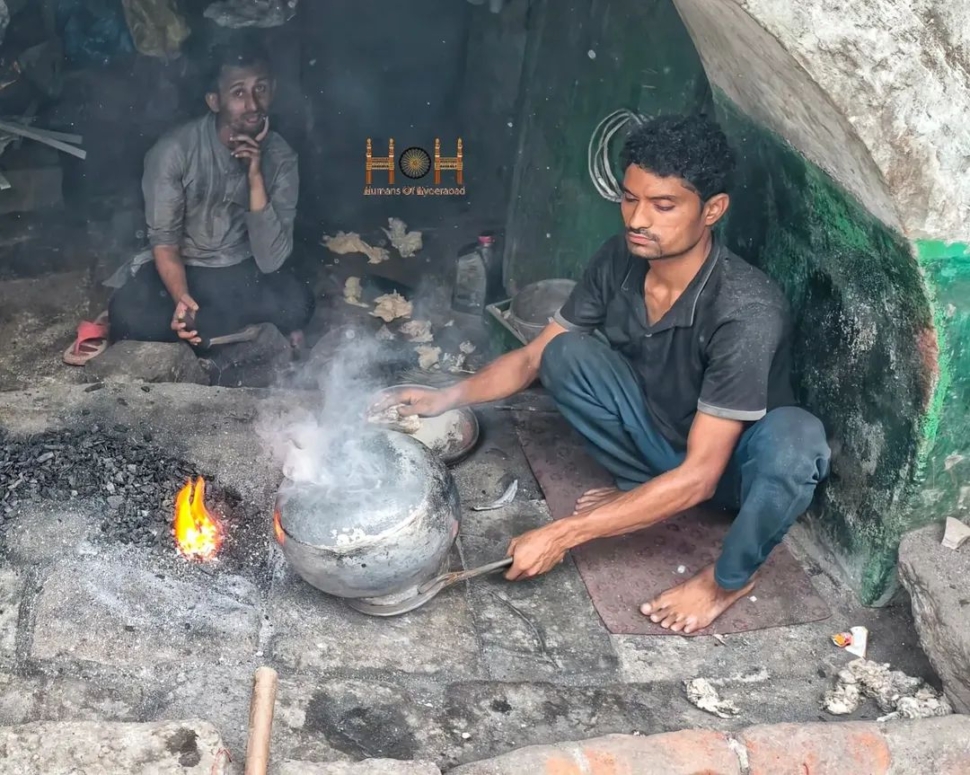
“We are the Kalaiwalas of Hyderabad. Not too long ago, you could hear our calls in every gali, moving from one lane to another, looking for work. Today, in this time of use-and-throw, those sounds have almost disappeared. The work we have been doing in Hyderabad for generations is slowly fading away.
This is not just a job for me. I learnt it from my forefathers. It is our family craft. We grew up watching them work and slowly learnt the same way.
In those days, almost every house had copper and brass vessels. When the coating wore thin, people would bring them to us for kalai. We would heat the vessel and put a fresh layer of tin, what we call ranga, on the inside.
I have been doing this work for 30 years now. It is hard work. When we get the big vessels used for Hyderabadi dum biryani or haleem, sometimes two or three of us have to work together. We stand near the fire, with all that heat coming at us. By the time the work is done, our clothes are wet with sweat and covered in soot. But when the vessel is finished, it shines like a mirror.
First, we clean the vessel properly. Then we heat it and carefully spread the tin evenly over the surface. You cannot learn this work from a book. You learn it by watching, doing it again and again, and gaining experience. There is no shortcut.
Over the years, things changed. People started using aluminium, then stainless steel. They were easier to maintain and needed less work. Slowly, our work became less. Many Kalaiwalas closed their shops and moved on to other work.
But these old vessels are not just vessels. They have something of their own. Food cooked in them tastes different. In Hyderabad, especially, you can feel that difference.
We are not asking people for much. We just need their support. If people continue to use these vessels and bring them to us, the work can continue.
Hyderabad has always respected people and their work. We have seen that kindness for many years. We only hope it continues.
Because when people support our work, this craft survives. And when this craft survives, we do too.”
— Khayyum