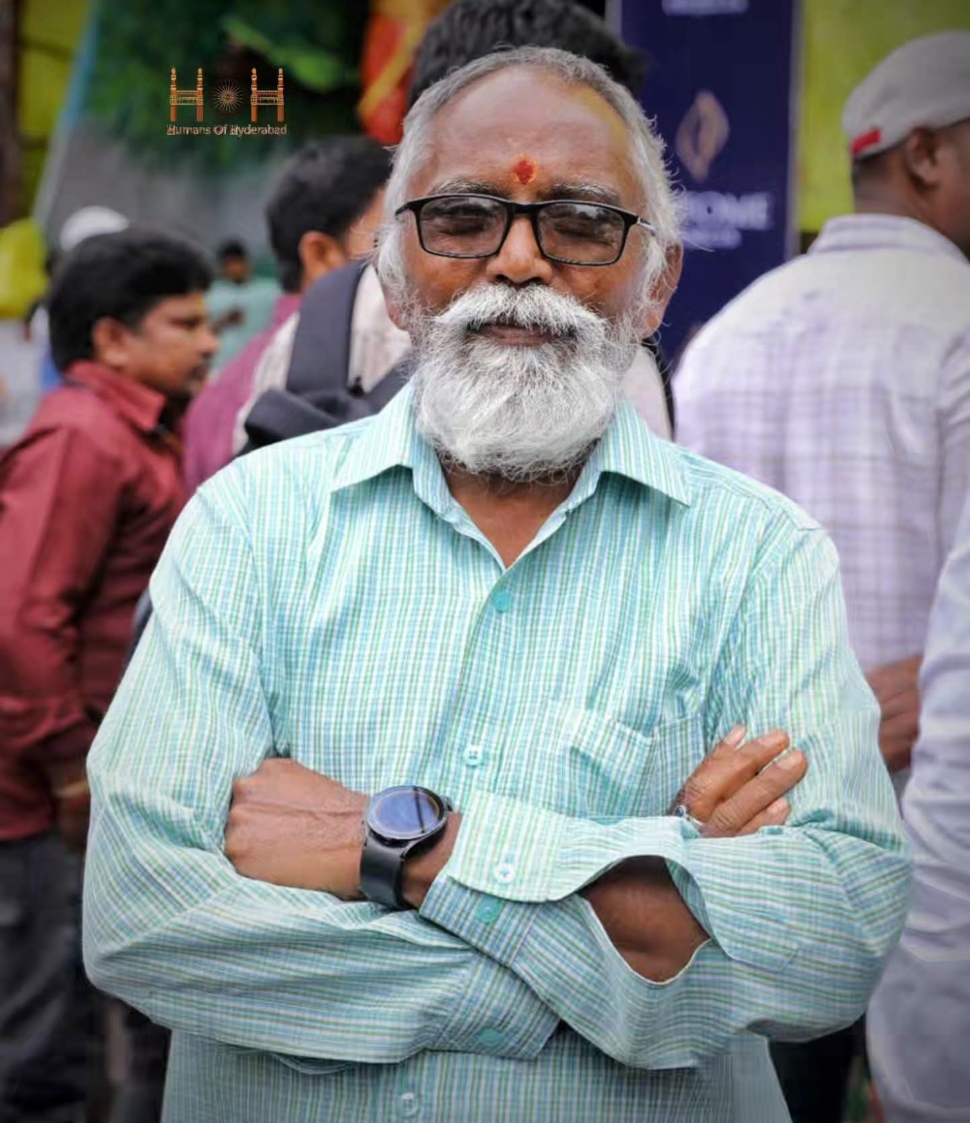
“When the Khairatabad Committee asked me to sculpt a 14-foot Ganesh idol in 1978, I was designing film sets at Ramakrishna Studios. I never imagined an assignment would reshape my life into a spiritual journey of seva.
My artistic journey began in the erstwhile Madras State when I joined well-known film set designer and builder Veluswamy in 1968-69. I was just 10 or 11 years old and would get 50 paisa for working on film sets. Later, I joined the team that designed ornaments for Senior NTR Garu for his mythological roles. I then moved to Hyderabad and started designing film sets.
People see one name, but the credit belongs to a team. I give the layout design and instructions, but 150+ carpenters, welders, clay artists, and painters from across India hold an equal role. Our work begins on Nirjala Ekadashi with Karra Puja, building the form layer by layer. We use an iron framework wrapped in dry grass, applying eco-friendly clay mixture along with rice husk and jute powder to prevent cracks.
The most sacred moment comes at the end. The responsibility of painting the eyes, the Nethralankaranam, rests solely with me. It is the culmination of our collective faith.
In 2006, I survived a major road accident near Bhongiri. I consider that survival the grace of Lord Ganesha, proving my hands were meant for this calling. For two months before the festival, my life changes: I eat once a day, cut out non-veg entirely, and spend every waking hour on the idol. For 2026, it stands as the towering 69-foot Panchamukha Sankatahara Maha Ganapati, alongside the Somnath Jyotirlinga and Kalika Mata shrines. The legacy started in 1954 with a one-foot idol by Singari Shankaraiah Garu.
Today, after nearly 50 years, I feel fortunate to carry it forward. The three months I spend here are the best months of my year. Whatever stands at Khairatabad is the result of many hands and hearts working as one. As long as we have strength, we will continue this seva.”
— Shilpi Chinnaswamy Rajendran