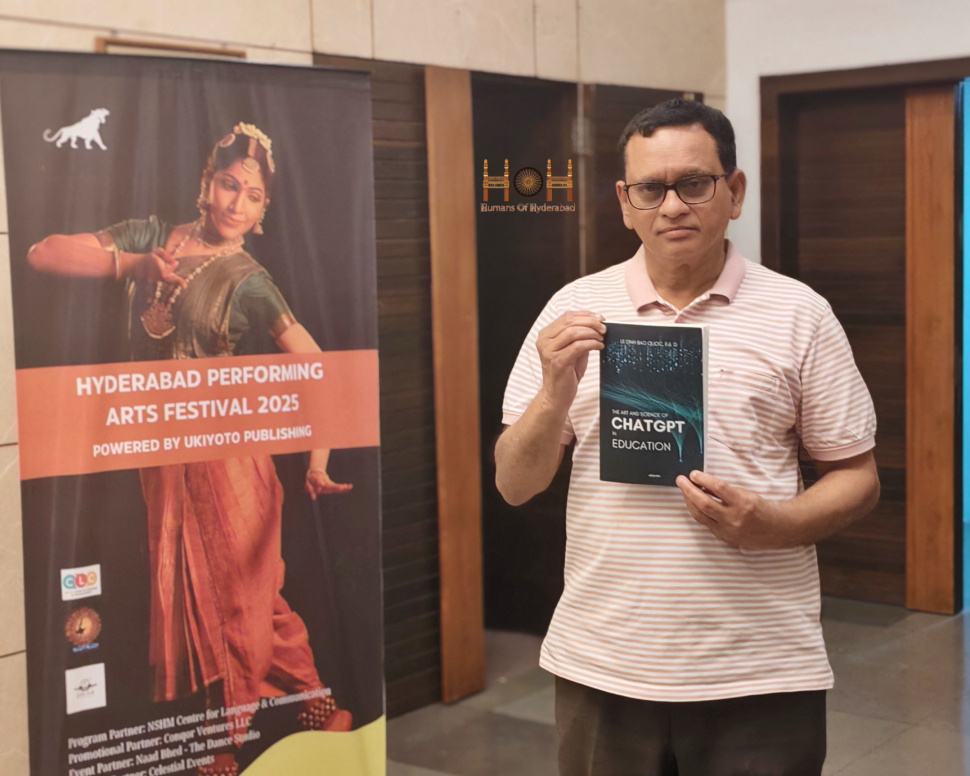
“I grew up in a small village near Gudivada in Krishna district, where life was modest but curiosity was abundant. My early education happened in private schools in the Gudivada Mandal region, and although our world had no computers, no laboratories, and no exposure to technology, it still had the space to imagine a larger future. After completing my matriculation in Gudivada and my intermediate in Gudlavalleru, I stepped into a bigger world with a B.Sc. (Engg) in Electrical Engineering from NIT Jamshedpur. The real turning point came when I joined the M.E. program in the Computer Science and Systems Engineering Department at Andhra University, a department that was then still shaping the foundations of computer science in India.
I joined the university as a lecturer and was fortunate to come under the guidance of Professor S. V. L. N. Rao, a remarkable geologist, remote sensing expert, and computer science visionary from IIT Kharagpur. Under his mentorship, I entered the field of image processing and began my thesis titled Textures: Their Characterization and Discriminance. Today we call these domains computer vision and pattern recognition, but at that time they were largely unexplored. There were no online resources, no ready-made datasets, and no digital convenience. Every research paper came through physical IEEE journals. Every experiment demanded patience. We worked with a foreign digital camera sourced through Professor Rao’s contacts and used it to capture texture images that eventually formed the base of my PhD.
I began my research in 1988, just a year after my son Arjun was born. My wife managed everything at home while I worked long hours across multiple labs — the Geoengineering Laboratory, the Center for Remote Sensing, and the Computer Science and Systems Engineering Lab. She carried the emotional and practical responsibilities of raising a child almost entirely on her own while I worked through equations, algorithms, and experiments. My colleagues supported me wholeheartedly, and with their encouragement I submitted my thesis in 1989 and completed my PhD in 1991.
Soon after, I joined Osmania University as a Reader, later becoming Professor and serving in various roles over the years: Head of the Department of Computer Science and Engineering, Chairman of the Board of Studies, Dean of the Faculty of Engineering, Dean of the Faculty of Informatics, Additional Controller of Examinations, and Director of the 21st Century Gurukulam, a collaborative initiative with APSCHE, IIIT Hyderabad, and Osmania University. I retired in 2020, completing more than four decades in academic life.
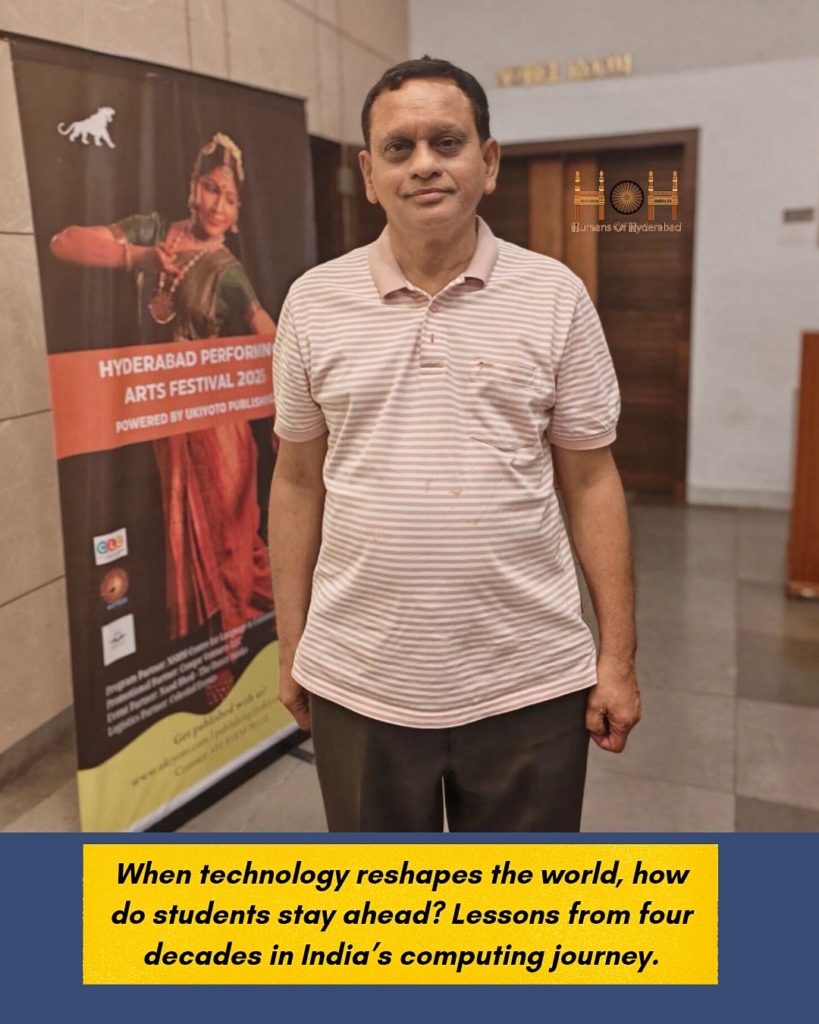
My career coincided with some of India’s most transformative technological phases. I witnessed the early IT push under Rajiv Gandhi Ji and Sam Pitroda Ji, the educational expansion under N. T. Rama Rao Garu, and the unprecedented engineering boom during the tenure of N. Chandrababu Naidu Garu. When he became Chief Minister, Andhra Pradesh had barely 32 engineering colleges. By the early 2000s, the number had risen to nearly 300. His vision was simple and revolutionary: every revenue division should have an engineering college so that even rural youth could access professional education. That single idea reshaped thousands of lives, and I feel fortunate to have witnessed this transformation from within the academic system.
People often ask me if sending students abroad created a brain drain. But what we once called brain drain eventually became brain gain. In the early 90s, when the dollar was worth only 16 rupees and visa processes were extremely challenging, those who reached the United States went on to contribute immensely — sending back money, knowledge, culture, and confidence. In my view, they strengthened India more than we expected.
Today, students are anxious about the rise of Artificial Intelligence and Machine Learning. They fear that AI will take away their jobs. But I believe that old jobs will disappear only to make room for newer, more advanced ones. AI will influence every field: medicine, law, manufacturing, defense, drug discovery, engineering, management, etc. For non-technical students, I always say that coding is not compulsory, but understanding AI applications is essential. Just as every professional once had to learn basic IT skills, in the future they will need basic AI literacy to stay relevant.
India is moving rapidly toward an AI-driven future. With the growth of machine learning, cybersecurity, data science, and emerging areas like quantum computing, the country is preparing for a new technological era. It is estimated that by 2030, nearly 25 lakh new jobs in India will be directly linked to AI and related fields. My caution to students is simple: without formal exposure to AI — even a basic certification — they may find themselves left behind. The earlier they begin, even from school-level classes like 6th or 7th, the stronger their future will be.
When I look back at my journey, from my village roots near Gudivada with no access to technology to four decades of teaching and research in computer science, I feel grateful. I have seen India transform, I have seen students evolve, and I have seen technology rise beyond anything we imagined. If my life stands for anything, it is that your place of birth does not define your destiny. Curiosity does. And as long as you are willing to learn, the world will keep opening new doors.”
– Dr. Premchand Parvataneni,
Professor, CSE
University College of Engineering
Osmania University, Hyderabad